
Frequently Asked Questions:
Why is Harris Health seizing city parkland?
-
Harris Health is seeking to condemn (seize) an 8.9 acre section of Hermann Park for use as a site for future expansion. It intends to build an 100-bed facility on the property within the next few years, and then intends to build a new Ben Taub Trauma 1 Hospital connected to that 100-bed facility in 20-30 years.
Harris Health intends to ask for $2.5 billion, in 2025 dollars. This is the maximum it can request, given its borrowing capacity. These funds must come from a new bond that has not even been introduced, let alone approved by taxpayers.
Additional funds may well be required; Harris Health would seek them from other sources.
In his December 1 meeting with the Hermann Park Conservancy board, Harris Health President & CEO Esmaeil Porsa estimated that the new Ben Taub would be completed in approximately thirty years (2055), assuming that voters approve another bond.
-
Commissioner Ellis has suggested that, in exchange for the Conservancy’s support of the condemnation, a parking garage could be built between Main Street and Fannin, next to Palmer Memorial Episcopal Church.
The garage would help provide parking for park visitors, potentially allowing some or all of the huge parking lot near the zoo to be converted to green space.
Many questions exist about this garage proposal, which would require complex negotiations among the County, the City, and the Medical Center Area Tax Increment Reinvestment Zone (TIRZ), and the Conservancy. Project details are unclear. The Zoo has made no statement about a reduction to its parking lot. No commitments have been made.
As Commissioner Ellis said on 1/29/26, “It is complicated… The City has to agree to let us go in, issues of whether or not it can issue debt have to be resolved. What is the cost to this Precinct for other projects? What is the cost to the City? How you operate it? How you maintain it?… A big problem, as in most cases, is MONEY - and, you know, everybody looks somewhere else for money…So I don’t want to give any false hope there.”
Will this garage ever happen? Who will pay for it? Even if the garage is eventually built, does the creation of additional parking justify the seizure of 8.9 acres of Hermann Park?
(Of course, the Conservancy’s long-standing plan for the 8.9 acres included a partially hidden, landscaped garage for 700+ cars, with a green roof.)
-
Ben Taub provides excellent and essential medical services for Harris County residents, especially the indigent and uninsured, and deserves full community support.
However, Houstonians voted for a bond that would renovate the current Ben Taub building and build a new 100-bed addition on the current site. They did not vote to use irreplaceable parkland for a new medical facility (to be completed in 30+ years).
Reasonable alternatives to seizing parkland appear to exist, and we as taxpayers and funders of this project are entitled to more information about these options.
We can both promote public health and protect valued parkland.
-
Yes. In 2023, taxpayers provided $1.6 billion for an entirely new LBJ Hospital, which is under construction and is scheduled to open in late 2028. This 1.2 million-square-foot Level 1 Trauma Center will include a 390-bed acute care emergency center, diagnostics, nuclear medicine, cardiology, labor and delivery, an inpatient tower, amd more. Two top floors of the tower will be built but left vacant for a future expansion to 450 beds.
In March 2023, Dr. Porsa stated that the new LBJ will result in “less need for transferring people from LBJ to Ben Taub, which is happening today, every day.”
After the new LBJ opens,Harris Health will use an additional $400 million of bond funds to renovate the existing LBJ building, providing even more capacity.
-
Harris County voters approved a bond measure that provided $2.5 billion to Harris Health, to “replace and renovate LBJ Hospital, extend the life of Ben Taub Hospital, and establish essential care services in high-need areas.” (bond book, p.2)
(Harris Health’s promotional bond book is here.)
The ballot language listed the projects it would fund, including “improving, renovating and developing…the Ben Taub Hospital Campus.” Harris Health’s bond stated that the proceeds from the bonds for Ben Taub would “address capacity management through renovation of existing space.” (bond book, p.10)
The bond information that voters received indicated that the funds would be used within the Ben Taub campus, not for condemning and acquiring more land.
Harris Health’s leaders changed their plans after the provision of taxpayer bond money. They have now declared that there is no viable alternative to building an entirely new facility on parkland, an option that was not placed before Harris County voters in the bond election.
-
As noted above, Ben Taub’s initial proposal was to renovate and expand its facilities on its 11-acre site. After at least four years of study, Harris Health had concluded that renovation was a feasible and prudent option at the time of the bond issue.
An internal analysis had concluded that the Ben Taub Tower could accommodate four more floors (in fact, its original plans anticipated this), and that three additional floors could be added to the building housing the NeuroPsychiatric Center (NPC).
Harris Health now contends that the NPC building can’t be expanded because the building is too old, and the existing spaces would have to be completely reconfigured. Where is the analysis of the building’s condition? What would be the cost of reconfiguring the existing spaces, and building more floors, as was originally proposed? Harris Health has produced no analyses, designs, or estimates.
If the NPC building is indeed in poor condition (which has not been proven), the 4 and 5 story complex could be removed and a large new building constructed on its 5.5 acre site, which also includes an inefficient surface parking lot. The site is directly across from Ben Taub’s emergency room.
The current Ben Taub building opened in 1990. Since then, renovations have included a $70 million bond-funded project to modernize and add more operating rooms, as well as extensive renovation of the old Ben Taub Tower to house speciality clinics, completed in November 2019, and a $48.5 million renovation of the Ben Taub Emergency Department, completed in September 2023.
Other investments include the upgrading of Ben Taub’s central plant, adding Thermal Energy Corporation utility delivery to provide chilled water and steam via underground pipes, and major expenditures on modernizing interventional radiology and MRI services within Ben Taub’s radiology suite.
Harris Health now claims it is more “fiscally responsible” to construct a new building on parkland rather than “throwing good money away on an old facility”, as a Harris Health representative described the option at the Precinct 1 public meeting.
Dr. Porsa stated that Ben Taub is now proposing the parkland seizure because “investing 400 million dollars on a rapidly aging and failing infrastructure just does not sound like a wise use of taxpayer money.”
This is a decision that the taxpayers were entitled to make in 2023, but they lacked full information about the proposed project.
-
Changing bond funds’ purpose after voter approval is an abuse of the public trust. Our city and county will need many more bond issues in the future, but situations like this cause voters to be suspicious of bond proposals.
Voters must be confident that public bond funds will be used for the specific projects that the voters approved.
We must protect the integrity of bond elections.
-
This is unclear. Parking is already a major problem at Ben Taub Hospital. Harris Health already spends $3 million a year for rental of off-site parking facilities for its staff.
In its Executive Summary and Proposed Budget for FY 2024, Harris Health’s Board stated that “Harris Health wishes to provide better parking resources for employees working at Ben Taub and Quentin Mease, where many employees are unable to park on-site due to limited capacity.
The objective in the near term is to obtain parking from Texas Medical Center to support as many as 800 employees and reassign shuttle routes to support the new location, thus minimizing the inconvenience and transit time for employees.
Long-term, the ideal would be to construct a dedicated garage for the workforce that further reduces overall commute times, which is expected to greatly increase employee satisfaction, recruitment and retention among the affected group.”
Has this issue been resolved?
Now Harris Health proposes to seize parkland to construct a new 100-bed facility, with no mention of an additional parking structure.
-
No. Investing hundreds of millions now (and billions later, with another potential bond) for new construction in the 100-year flood plain is an unwise use of taxpayer dollars. In fact, Texas law prohibits it: “Construction of a new hospital is prohibited in a designated 100-year flood plain.” 26 Tex. Admin. Code §505.162 (a)(2)(C)(i).
New construction would remove grandfathering and trigger new flood detention requirements for the entire campus, including expensive flood walls and detention infill.
-
No. The land will be very expensive.
Because the Warnecke family, which generously donated the parkland to the city, required that it be used exclusively for park purposes, the 8.9 acres will revert back to the donor family unless Harris Health buys the land from them.
The cost of the land is under discussion. Real estate professionals have suggested that the 8.9 acres could have a market value of as much as $100 million.
This means that Harris Health may use a quarter of the entire 2023 bond sum solely for acquiring the land.
-
Under Texas law, public parkland cannot be taken for a proposed use unless there is no other ‘feasible or prudent’ alternative to the taking.
The developer must show that the project “includes all reasonable planning to minimize harm to the land”, and a public hearing must be held before approval of the seizure.
To date, Harris Health has not provided persuasive evidence that no other alternative exists. The legally required public hearing is tentatively scheduled for March 19, 2026.
-
When informing the Conservancy of this project in April 2024, Harris Health mentioned a potential “land swap”, possibly involving a portion of the current Ben Taub site.
In June 2025 Harris Health announced that it would simply condemn the land. The donors’ heirs must receive payment equal to the fair market value of the land (an estimated $80-$100 million); the City of Houston is also likely to receive payment.
Due in part to the widespread objections to this project, discussions are now underway regarding a new parking garage next to Palmer Memorial Episcopal Church. This garage would benefit the Conservancy, as it would provide more parking for park visitors.
However, light rail and one-way streets make the location tricky (it would require a pedestrian walkway over the traffic lanes and rail), and thus far there has been no formal public agreement about cost, design, maintenance, operation, construction funding, whether the Conservancy would receive any of the garage revenue, and to what extent the garage would serve both the Medical Center and the Park.
At one point there was discussion of removing some of the 11 acres of parking lot in front of the zoo and returning it to parkland, which would help compensate the Conservancy for the loss of the 9 acres. However, this option is apparently no longer being considered.
-
Hermann Park is a beloved oasis in our dense city, serving as a priceless refuge for six million visitors a year.
A Rice University study found that the ethnic breakdown of Hermann Park users reflects Houston’s diversity (39% White, 31% Hispanic, 14% Black, 13% Asian), and Houstonians’ love for the park is reflected in their financial support. In 2023, for example, the Conservancy received over more than 41,000 gifts of $100 or less, from 151 of Houston’s 178 zip codes.
Despite solid evidence that green space provides many physical and mental benefits, Houston lacks enough centrally located parks.
Each year, the national Trust for Public Land ranks the nation’s major cities based on the quality and accessibility of their parks. In its 2025 ranking, Houston ranks 66th in the country in quality of its parkland, and 8th in the state, trailing Dallas, Austin, San Antonio, El Paso, Plano, Frisco, and Arlington.
The Houston-Galveston Area Council predicts Houston will have 3.6 million more residents by 2050. Our city and county must maintain all parkland to accommodate this growth. Once parkland disappears, it is gone forever.
-
Many Houstonians remember when the park’s lovely reflection pool was a ragged mud pit, or when large stretches of the hugely popular Commons were simply barren dirt. Investment in quality design, construction, and maintenance turned these areas into destinations that we treasure.
The Hermann Park Conservancy has similar plans (described in another section of this site) for Bayou Parkland West, the area that Harris Health is working to condemn.
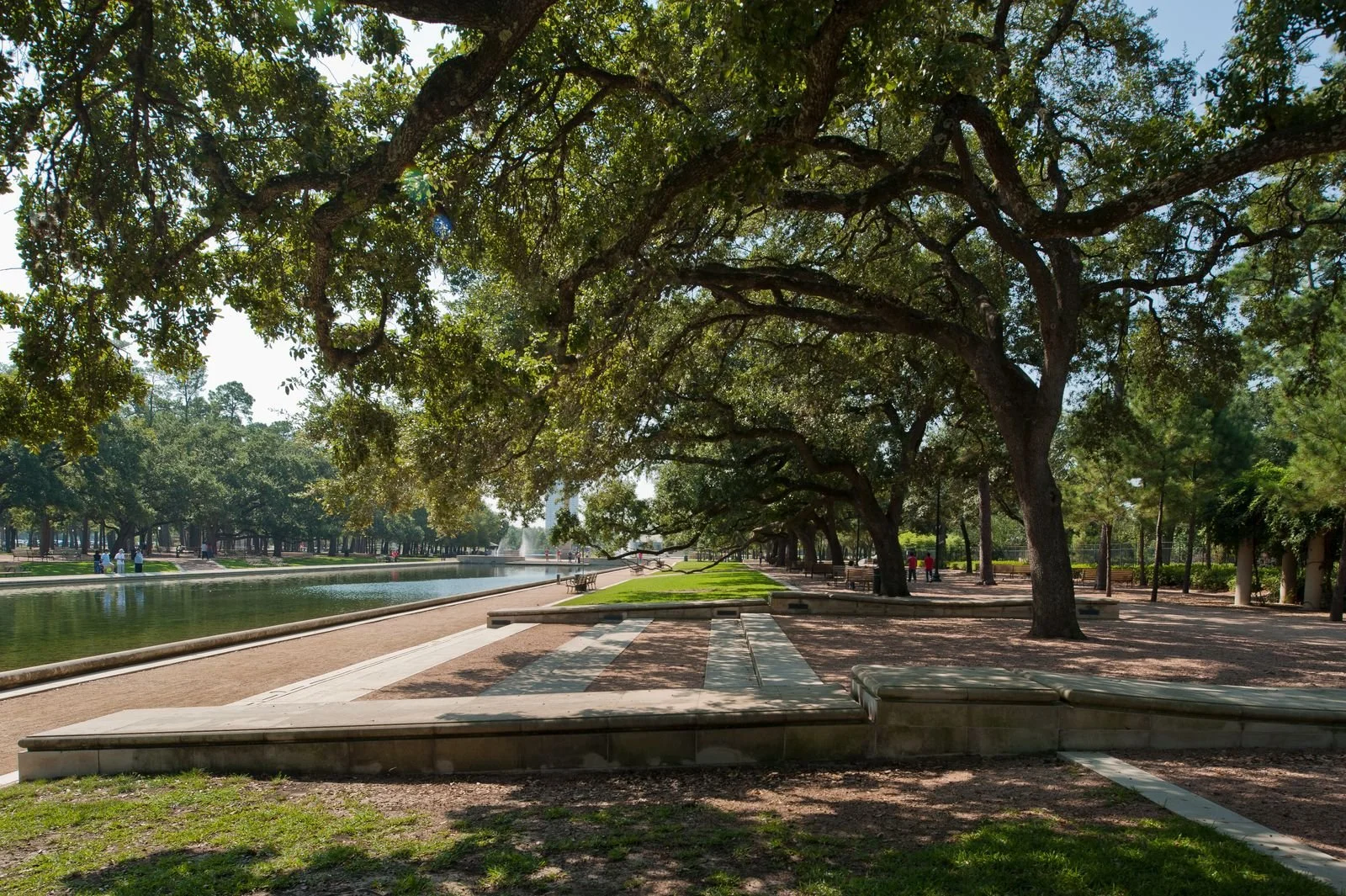
Simply as an expanse of grass, 100-year-old live oaks, and benches, these 8.9 acres currently provide valuable open space for walking, gathering, and reflecting, with the environmental benefits that trees and water-absorbing grassy areas provide.
(Given the lessons learned during 2001’s Tropical Storm Allison, it seems imprudent to remove this storm water buffer and build a new hospital on the banks of the bayou.)
-
Harris Health has said repeatedly that seizing part of Hermann Park through the process of eminent domain is the most economically viable alternative for its expansion.
Under Harris Health’s reasoning, public operators of other health facilities, affordable housing complexes, public safety structures, and similar entities could argue that they should be able to condemn scarce parkland for their important purposes, as a cost-effective method of obtaining land. This is shortsighted and misguided public policy.
There will always be worthy public needs that require construction, but parkland should not be seen as undeveloped land.
This principle is one of the most important issues that this attempted condemnation presents. If we simply accept this taking of parkland, we can expect more seizures of our public open space in the future.
-
Harris Health has not provided a thorough analysis of competing options, including building on porous areas of the 11-acre Ben Taub campus, as required by Texas statute.
Beyond the renovation and expansion possibilities within the Ben Taub campus, the Medical Center contains other potential expansion sites.
A six-acre property is located less than 350 feet from Ben Taub. At least half of this site is owned by the City of Houston and is for sale. This site could be connected to Ben Taub by a 350’ skybridge or walkway.
Urban designer Keiji Asakura, who has 40 years of planning experience at the acclaimed firm of Asakura Robinson, analyzed this site and suggested two specific locations for the 100-bed facility. Harris Health has provided no analysis explaining why it rejected this site.
Baylor’s School of Medicine and School of Health Professions (part of Baylor College of Medicine), next to Ben Taub, is currently moving to the new Lillie & Roy Cullen Tower in the Medical Center’s Helix Park. The new 800,000 square foot structure will integrate education, research, and patient care.
What is the future of the 90,000+ square foot building that the students will be vacating? Baylor has stated that it will be adapting the space for laboratory research.
Where is Harris Health’s analysis of this large contiguous site? A portion could accommodate an 100-bed facility or addition, through lease, purchase, or condemnation. If Harris Health has studied this possibility it has provided no documentation.
Note: Harris Health claims that the Baylor building’s historic status is an obstacle to adaptive reuse. In fact, Texas Historic Landmarks are not legally protected. They may be remodeled and have additions placed over or behind them. (They may even be demolished, which is not, and should not be, under consideration here.) The only requirement is a 60-day review by the Texas Historical Commission.
Other areas of interest include a surface parking lot (an inefficient use of space) directly across the street, as are low-rise structures such as Baylor College of Medicine’s loading dock area, potentially obsolete with the relocation of the College. These may well not be suitable for use, possibly in combination with other sites. But where is the analysis?
The Medical Center has undergone robust expansion to the south and west, with valued partners such as Baylor moving to the Helix Park area, in reasonable proximity to Ben Taub. Although facilities there would not be contiguous, could some outpatient, administrative, or other functions move to convenient nearby, but not contiguous, locations, freeing up campus space?
Taxpayers deserve, and Harris Health is required to provide, a careful, unbiased analysis of competing sites and options.
-
Unfortunately, Harris Health’s interactions with Houstonians on this issue have been disappointing.
For example,
Facilities Master Plan
In 2020, Harris Health prepared a Facilities Master Plan, including a report on Ben Taub. It has refused to release this report, even after a formal Public Information Act request. It referred the request to the Texas Attorney General for review. This document should be shared with Harris County residents.
Meeting Video
The Harris Health board discussed its Strategic Plan in a formal meeting on December 1, 2020. The video of this meeting is missing from the Harris Health website. This is the only 2020 board meeting to lack an online video. A request for the video via the Public Information Act has been met with no response, despite followups.
Lack of Public Engagement
Harris Health offered little opportunity for a full public discussion of the land seizure. In response to Harris County Commissioners Court’s requirement that it expand public input, Harris Health scheduled four public meetings (one in each of the four county precincts).
Public Unable to Ask Questions
Three of the four meetings featured polished presentations about Harris Health’s important work and remarks by Harris Health representatives.
Neither representatives of the Hermann Park Conservancy nor members of the public were allowed to speak, and could only submit written questions; Harris Health selected the questions to be answered.
(Questions were permitted in the Precinct Four Town Hall and, to a limited extent, in a Town Hall hosted by the Hermann Park Conservancy.)
Misleading Map
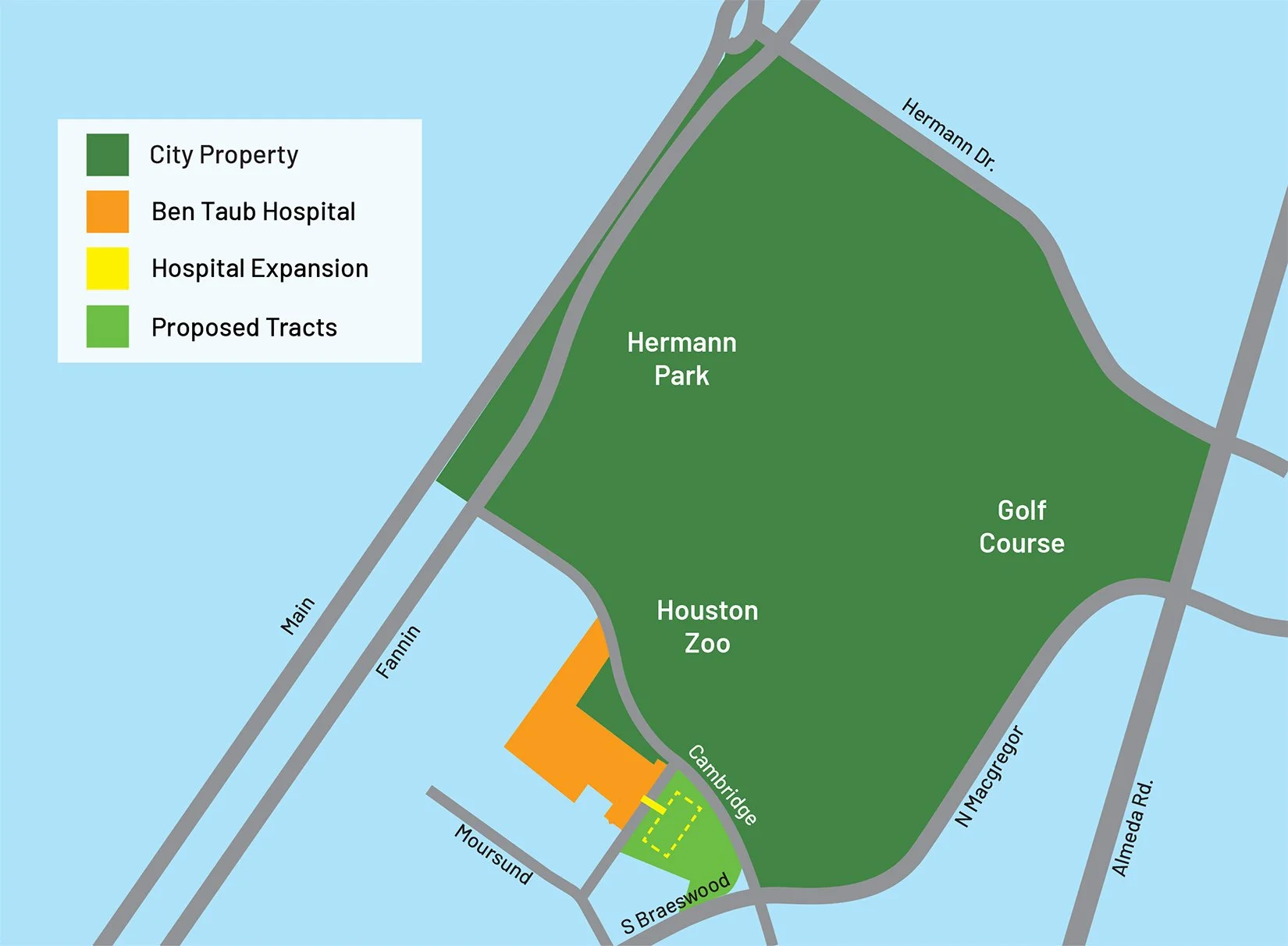
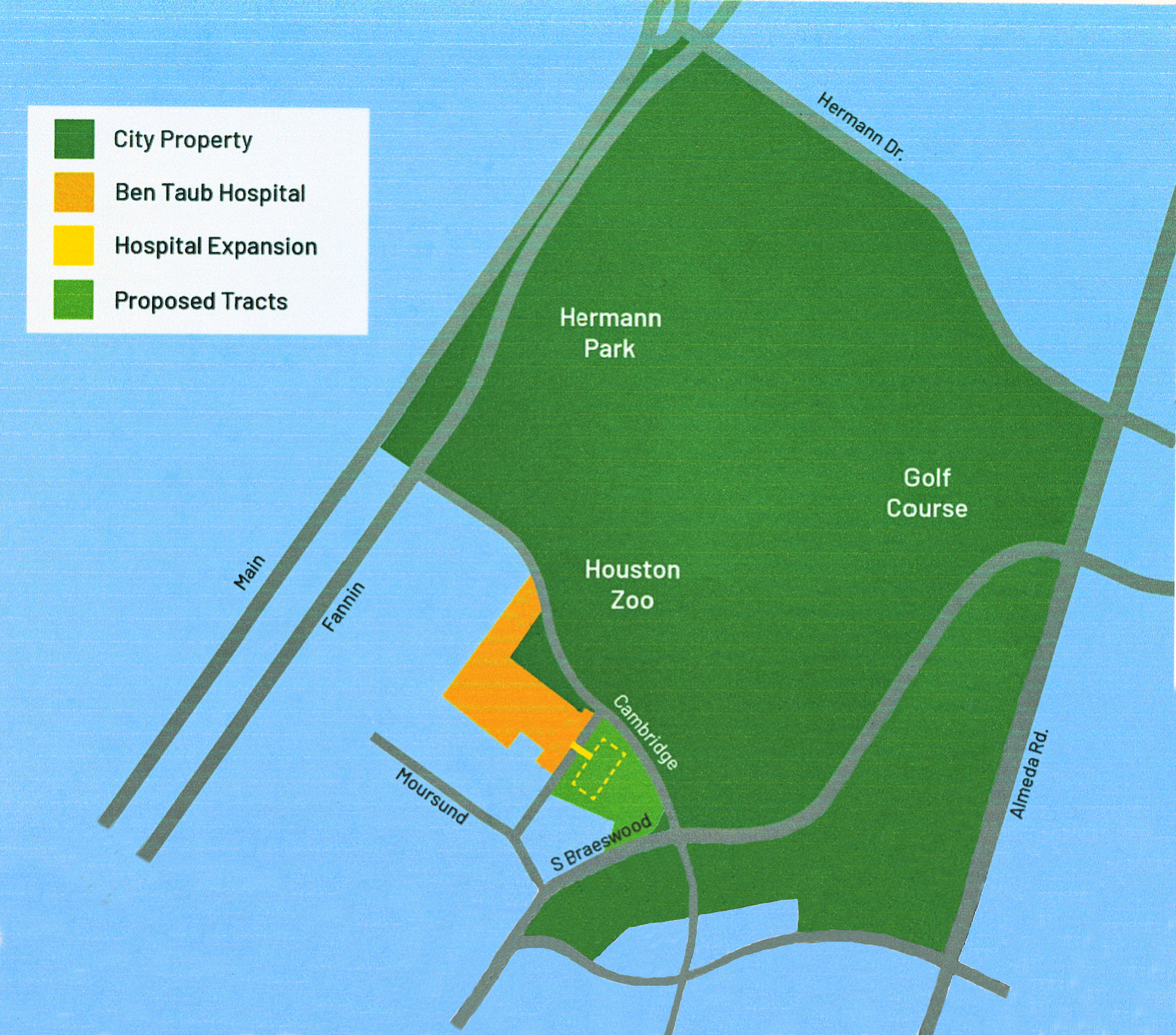
For at least five months, Harris Health shared and displayed an inaccurate map of Hermann Park, giving the false impression that the targeted parkland is separate from Hermann Park.
Their map is below, with the lime green section showing Bayou Parkland West. It suggests that the 8.9 acres are removed from, and incidental to, the park.
The accurate map is to the right. Hermann Park actually borders the targeted land on two sides. Although many Houstonians pointed this out to Dr. Porsa and his staff through the summer and fall, Harris Health continued to display the misleading map until December 2025.
Lack of Contact with Conservancy
Since initiating this project, Harris Health did not communicate effectively with the Hermann Park Conservancy, the parks’ stewards since 1992.
Recognizing this issue, in October 2025 the Harris County Commissioners Court directed Harris Health to meet with Hermann Park Conservancy Board at least twice before Jan. 20, 2026.
Misleading Bond Materials
Harris Health consistently denies that its bond book and other voter education materlals were misleading about the Ben Taub project.
However, the public materials referred only to renovations on the Ben Taub campus and never mentioned moving off site or seizing public parkland.
County residents deserve clear, timely, and accurate information about this important project.
Harris Health’s inaccurate park map
Accurate park map